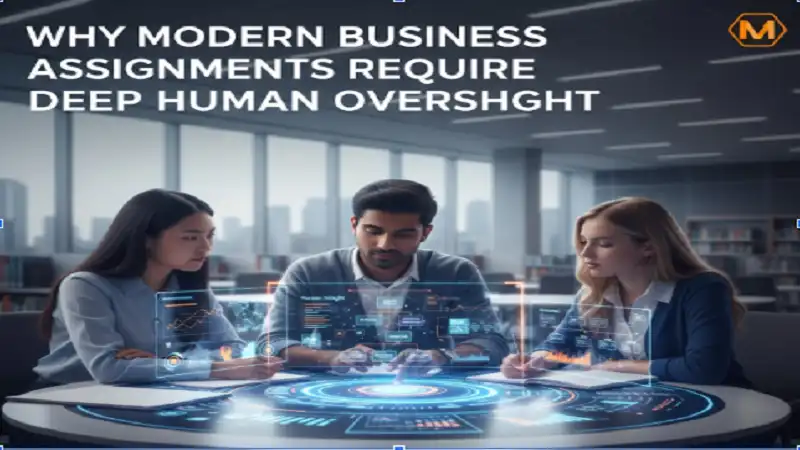
The global business landscape of 2026 is a whirlwind of rapid technological shifts, fluctuating market sentiments, and a heightened focus on corporate ethics. For students pursuing degrees in commerce, management, or international business, the stakes have never been higher. While the rise of sophisticated algorithms and automated systems has streamlined many data-driven tasks, a dangerous misconception has emerged: the idea that business assignments can be “outsourced” entirely to software.
In reality, the most successful business leaders of the future are those who recognize that technology is merely a tool, not a replacement for the human mind. Modern business education is no longer just about memorizing the four P’s of marketing or calculating a balance sheet. It is about understanding the “why” behind every corporate decision and navigating the grey areas where logic alone isn’t enough. This is why deep human oversight is the secret ingredient for any academic project that aims for a top-tier grade.
When students tackle complex case studies, they often find that automated tools miss the bigger picture. For instance, an AI might suggest cutting costs by reducing staff in a struggling department, but it won’t understand how that move destroys company culture or triggers a PR nightmare that devalues the brand. This is where professional guidance becomes essential. If you are struggling to balance these complex variables, seeking my assignment help can provide the clarity you need. By using a service like myassignmenthelp, you gain access to human experts who understand that a business is a living organization made of people, not just a set of data points on a spreadsheet. These experts help you bridge the gap between “robotic” answers and the deep, analytical thinking that professors actually want to see.
The Trap of “Perfect” Data and Algorithmic Bias
We live in an era of big data. Every business assignment today seems to require a deep dive into analytics, spreadsheets, and forecasting models. It is tempting to think that because a computer generated a graph, the graph must be right. But in the current professional climate, we are seeing more “algorithmic bias” than ever before. If the historical data fed into a system is flawed or reflects past prejudices, the output will be even worse.
Human oversight acts as a crucial filter. A student must look at the data and ask: Does this actually make sense for a human customer in today’s social climate? Machines are great at identifying mathematical patterns, but humans are the masters of context. Without a human checking the work, a business assignment is just a collection of numbers without a soul. It lacks the “gut feeling” that has guided the world’s most successful entrepreneurs.
Strategic Alignment: The 2026 Business Challenge
One of the most popular topics in modern business schools—and the central theme of sites like Misalignment.net—is “Strategic Alignment.” This concept explores how a company’s technology, its people, and its long-term goals all point in the same direction. When these things don’t match, we call it “misalignment.” Many students fail their assignments because they focus on the technology or the profit margins but ignore the human element.
To get a top grade, your paper must show how a manager keeps everyone on the same page. This requires empathy, leadership, and ethical judgment—qualities that no software has mastered yet. When you write about leadership, you aren’t just describing a process; you are describing a human relationship. Strategic alignment is as much about psychology as it is about systems.
Why “Assignment Help Marketing” is Growing
As the bar for academic excellence rises, students are looking for more than just generic tips. They need specialized insights that reflect current industry standards. The field of Assignment Help Marketing has shifted to focus on high-level mentorship and subject-matter expertise. In 2026, the best services don’t just “give answers”; they provide frameworks that help students think like future CEOs. This type of marketing succeeds because it recognizes that students aren’t looking for a shortcut—they are looking for an edge in a highly competitive global market where the difference between a ‘B’ and an ‘A’ can determine their career trajectory.
4. Navigating Ethical Dilemmas in Business
Ethics is perhaps the most important reason why human oversight is non-negotiable. In a modern business assignment, you might be asked to solve a dilemma involving environmental impact or fair wages. An automated tool might prioritize profit because that is what it was programmed to do—this is the classic “alignment problem” where the machine’s goals don’t match human values.
A human student, however, can weigh the moral cost of a business decision.
- Sustainability: Is the company truly “green,” or are they just using marketing tricks to appear eco-friendly?
- Fairness: Are the workers in the supply chain being treated with dignity, or is the profit coming at the expense of human rights?
- Transparency: Is the brand being honest with its customers about data privacy?
These are not questions for a machine. They are questions for a future leader who cares about the world they are building.
The Importance of a Global Tone in Communication
Modern business is global. An assignment written today needs to consider how a decision in New York affects a factory in Vietnam or a customer in Brazil. This requires a “Global Tone”—a style of writing that is clear, respectful, and aware of different cultures. Using simple, direct language ensures that your ideas are understood by everyone, regardless of their first language. It also makes your writing more professional and authoritative.
When you write for a global audience, you have to avoid slang or regional metaphors that might confuse a reader. Instead, focus on universal business principles. This clarity is what professors look for when they grade papers on international business or global supply chain management.
The Role of Critical Thinking in Case Study Analysis
Case studies are the bread and butter of business education. They require you to step into the shoes of a manager and make a difficult choice. If you use a basic AI to analyze a case study, it will likely give you a “safe” answer that sounds like a textbook. But textbooks don’t win in the real world—innovation does.
Human oversight allows you to challenge the status quo. Maybe the “standard” business move is the wrong one for this specific scenario. Maybe the company needs to take a bold risk that an algorithm would find too “illogical.” Showing this level of critical thinking is what separates a student from a practitioner. It shows that you aren’t just repeating what you’ve been told, but that you are actually processing the information and forming your own unique perspective.
Overcoming the “Template” Mentality
Many students fall into the trap of using templates for their assignments. While templates provide a good structure, they often lead to boring, repetitive content that fails to engage the reader. Business is about storytelling—convincing a board of directors, an investor, or a customer to believe in your vision.
A human touch adds flavor to the writing. It allows for a narrative flow that connects the introduction to the conclusion in a way that feels natural. When a human expert reviews your work, they check for this “flow.” They ensure that the tone is consistent and that the arguments build upon each other logically. This is something that automated “spinners” or basic writing tools simply cannot replicate.
Understanding Market Nuance and Consumer Psychology
Business is ultimately about people buying things from other people. Understanding consumer psychology is a deep, complex task. Why do people buy a certain brand of sneakers even if they are more expensive? Why does a specific marketing campaign go viral while another one fails?
These questions involve human emotions like pride, fear, joy, and the desire for belonging. When writing a marketing assignment, you must be able to tap into these emotions. You have to explain how a brand makes a customer feel. If your assignment lacks this emotional intelligence, it will feel cold and academic. Human oversight ensures that your marketing strategies are grounded in the reality of human behavior.
The Evolution of Academic Standards
Universities are becoming much better at detecting work that lacks human depth. They use advanced tools to check for “robotic” patterns and lack of original thought. This means that “good enough” is no longer good enough. To succeed, your work must be original, deeply researched, and clearly argued.
By focusing on deep human oversight, you are future-proofing your education. You are learning the skills that will remain valuable even as technology continues to advance. Employers in 2026 aren’t looking for people who can operate a software program; they are looking for people who can think critically, lead teams, and solve problems that don’t have a clear-cut answer.
Practical Tips for Maintaining Oversight in Your Work
If you are a student looking to improve your grades while maintaining your integrity, keep these tips in mind:
- Draft First, Research Second: Try to write down your own thoughts and ideas before looking at what the internet says. This ensures your “voice” is the foundation of the paper.
- Read Out Loud: This is the easiest way to find “robotic” or awkward phrasing. If it sounds strange when you say it, it will feel strange to the person grading it.
- Cross-Reference Everything: Don’t trust a single source. Check your data against multiple reputable business journals or news outlets.
- Seek Mentorship: Don’t be afraid to ask for help from those who have been there before. Whether it’s a professor or a professional academic service, getting a second pair of human eyes on your work is always a good idea.
Final Thoughts: The Human Advantage
In conclusion, while technology is a powerful tool, it is not a replacement for the human mind. Modern business assignments are designed to test your ability to think, feel, and lead in an increasingly complex world. By providing deep human oversight to your work, you ensure that your assignments are not just technically correct, but also strategically sound and ethically responsible.
Whether you are discussing the intricacies of “misalignment” in AI systems or the challenges of global marketing, remember that the most important element is the human perspective. In a world full of automated noise, the person who can provide a thoughtful, human-centric analysis is the one who will truly stand out—both in the classroom and in the boardroom.
The future of business belongs to those who can bridge the gap between high-tech data and high-touch human insight. By focusing on quality, ethics, and clear communication, you aren’t just finishing an assignment; you are preparing yourself to lead the next generation of global industry.
About The Author:
Min Seow is a professional educational consultant and academic writer with over a decade of experience. Specializing in engineering and finance disciplines, Min provides strategic guidance to help students navigate complex international education systems at myassignmenthelp.
Reed More: misalignment